Wastewater treatment plants (WWTPs) generate sludge as an essential by-product of the treatment process. Although sludge is an expected part of wastewater treatment, its high water content can create challenges for handling, transportation, further treatment, and final disposal.
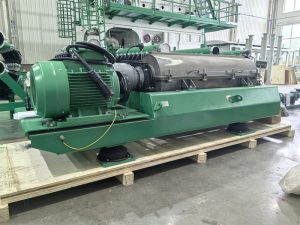
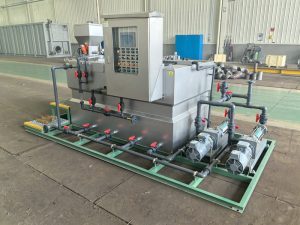
To address these challenges, GN Separation has recently supplied a complete sludge dewatering centrifuge package for an overseas wastewater treatment plant. The system combines a high-speed decanter centrifuge with an automatic chemical dosing unit to provide continuous solid-liquid separation and sludge dewatering.
Sludge Dewatering in Wastewater Treatment
Sludge generated by municipal and industrial wastewater treatment processes can contain a high percentage of water. Before the sludge can be transported, further processed, or disposed of, reducing its water content can help decrease its overall volume and improve handling characteristics.
Mechanical dewatering is therefore an important stage in many wastewater treatment processes. Instead of relying only on natural settling or drying, mechanical equipment can continuously separate water from suspended solids under controlled operating conditions.
A properly designed sludge dewatering system can help produce a more concentrated and manageable sludge cake while separating a liquid stream that can be directed to an appropriate stage of the wastewater treatment process.
Combining Chemical Conditioning and Centrifugal Separation
The performance of sludge dewatering depends not only on the separation equipment but also on the characteristics of the sludge entering the system.
Fine suspended particles can be difficult to separate directly because of their small size and physical properties. Chemical conditioning can improve the separation process by promoting the aggregation of fine particles into larger flocs.
In the GN package, the automatic chemical dosing unit prepares and injects the appropriate polymer solution into the sludge before it enters the centrifuge. This conditioning process promotes floc formation and improves the ability of the centrifuge to separate the solid and liquid phases.
The conditioned sludge is then continuously fed into the high-speed decanter centrifuge, where centrifugal force accelerates the separation process.
High-Speed Decanter Centrifuge
A decanter centrifuge uses centrifugal force to separate solid particles from liquid. During operation, the sludge enters the rotating bowl, where the difference in density between the solid and liquid phases causes the solids to move toward the bowl wall.
A rotating conveyor transports the separated solids toward the discharge end of the machine, while the clarified liquid is discharged separately.
For wastewater treatment applications, GN’s environmental decanter centrifuges are designed for sludge dewatering, sludge thickening, and other solid-liquid separation applications. The equipment is intended for continuous operation and can be controlled using PLC and VFD systems.
The objective of the process is to achieve an appropriate balance between solids recovery, cake dryness, liquid clarification, polymer consumption, and energy consumption.
Integrated Package for Overseas WWTP Projects
For international wastewater treatment projects, system integration is an important consideration. The dewatering system may need to be transported over long distances, installed in limited spaces, and commissioned under different site conditions.
Instead of treating the centrifuge as an isolated machine, an integrated package can combine the main separation equipment with the systems required for sludge conditioning and operation.
A typical configuration may include:
- Sludge feed system
- Automatic polymer preparation and dosing unit
- High-speed decanter centrifuge
- Electrical and control system
- Piping and instrumentation
- Sludge cake discharge arrangement
- Centrate collection and discharge system
The exact configuration depends on the characteristics of the sludge and the requirements of the WWTP.
Why Continuous Dewatering Can Be Important
One of the main advantages of centrifugal dewatering is continuous operation. Unlike batch-oriented processes, a decanter centrifuge can continuously receive conditioned sludge, separate the liquid and solids, and discharge the dewatered cake.
This can be useful for wastewater treatment plants that need to process sludge on a regular basis without frequent interruptions for filter replacement or manual cleaning.
GN’s environmental decanter centrifuges are designed without filter cloths or belts, eliminating the need for those components to be routinely replaced. The machines are also designed with wear protection in areas exposed to abrasive solids.
Adapting the System to Different Sludge Conditions
Not all wastewater sludge behaves in the same way. Primary sludge, activated sludge, digested sludge, DAF sludge, and mixed sludge can have significantly different dewatering characteristics.
For this reason, equipment selection should consider more than the nominal feed capacity. Important parameters can include:
- Feed flow rate
- Feed solids concentration
- Sludge type
- Particle size distribution
- Polymer type and dosage
- Required solids recovery
- Desired cake dryness
- Characteristics of the separated liquid
Laboratory or pilot testing can be useful when determining the appropriate operating parameters for a specific sludge.
Supporting More Efficient Sludge Management
The purpose of dewatering is not simply to remove water. The larger objective is to produce a sludge stream that is easier and more economical to manage.
Reducing the water content can decrease sludge volume and potentially reduce transportation and disposal requirements. A dewatered cake can also be easier to handle during subsequent treatment or disposal.
At the same time, the separated liquid, commonly referred to as centrate, can be directed to the appropriate treatment stage depending on the design of the WWTP.
GN Separation for Wastewater Treatment Applications
GN Separation provides separation and conveying equipment for environmental and wastewater treatment applications, including sludge dewatering and wastewater solid-liquid separation. Its environmental product range includes decanter centrifuges, disc stack separators, vibrating screens, and other equipment used for separation and material handling.
The GN sludge dewatering centrifuge package for overseas WWTP applications demonstrates how chemical conditioning and centrifugal separation can be combined into an integrated process.
By considering the sludge characteristics, required treatment capacity, polymer conditioning, solids recovery, cake dryness, and overall plant configuration, the dewatering system can be configured to meet the practical requirements of each wastewater treatment project.