Diamond core drilling is widely used in Australia for mineral exploration, geological investigation, and resource development. Unlike large-scale drilling operations, diamond core drilling projects are often carried out in remote locations where equipment must be compact, reliable, easy to transport, and capable of operating with limited infrastructure.
One of the challenges in these operations is the management of drilling fluids. Drilling mud is essential for cooling and lubricating the diamond bit, carrying drilled particles to the surface, stabilizing the borehole, and maintaining efficient drilling conditions. However, once the drilling fluid becomes contaminated with fine solids, its performance can deteriorate. Efficient solids separation and fluid recovery can therefore play an important role in maintaining drilling performance while reducing water and waste requirements.
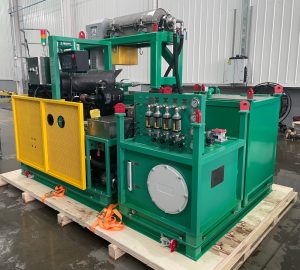
The GN Hydraulic Drive Centrifuge Unit is designed specifically to address these requirements in diamond core drilling and geological exploration applications.
A centrifuge designed for remote drilling locations
A major advantage of the hydraulic-drive configuration is that the centrifuge can operate without depending on a conventional electrical power supply for the centrifuge drive system. In GN’s hydraulic configuration, a diesel engine powers the hydraulic system, which drives both the centrifuge and the feeding system.
This configuration can be particularly useful for exploration projects operating far from established infrastructure. Remote drilling locations may have limited access to electrical power, and transporting additional electrical-generation equipment can increase the logistical burden of the project.
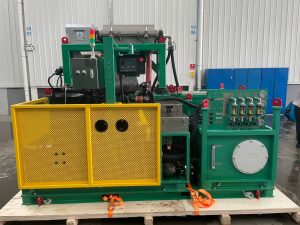
The hydraulic configuration provides an alternative approach that integrates the power source and separation equipment into a compact package.
Improving drilling fluid recovery
During diamond core drilling, drilled solids progressively accumulate in the drilling fluid. If these solids are not removed efficiently, they can affect fluid properties and increase the volume of mud that must eventually be discarded.
A decanter centrifuge separates suspended solids from the liquid phase by applying centrifugal force. Fine particles that are difficult to remove using conventional screening equipment can be processed by the centrifuge, allowing a significant portion of the liquid phase to be recovered.
The recovered drilling fluid can then potentially be returned to the drilling process, depending on the required fluid properties and site procedures.
This approach can provide two important benefits: reduced consumption of fresh water and reduced drilling-fluid waste.
Compact equipment for challenging terrain
Mining exploration projects in Australia can involve difficult terrain, long transportation distances, and restricted access. Equipment that can be transported and installed efficiently can therefore provide an important operational advantage.
GN’s hydraulic-drive mini centrifuge configuration uses a modular and relatively lightweight design. The equipment can be configured to meet transportation requirements for remote exploration projects, including applications where lifting and mobilization considerations are important.
For diamond drilling contractors, this means the separation system can be considered as part of the overall drilling package rather than as a large stationary treatment plant.
Supporting more efficient solids management
The purpose of using a centrifuge is not simply to remove solids. The broader objective is to manage the drilling fluid more efficiently.
A typical process can involve collecting contaminated drilling fluid, removing larger solids through primary solids-control equipment, and then using the centrifuge to separate finer suspended particles. The resulting liquid can potentially be reused, while the separated solids are collected for appropriate handling and disposal.
The exact configuration depends on drilling-fluid properties, solids concentration, particle-size distribution, flow rate, and the required quality of the recovered fluid.
A practical solution for Australian mineral exploration
For Australian diamond drilling contractors, equipment selection often has to balance separation performance with mobility, power availability, maintenance requirements, and transportation constraints.
A hydraulic-drive centrifuge can be particularly attractive when the drilling operation is located in a remote area and conventional electrical infrastructure is limited.
GN has supplied hydraulic-drive centrifuge units for diamond core drilling and geological exploration applications, demonstrating the suitability of this configuration for specialized mineral exploration projects.
For more information about GN’s separation technology, visit GN Separation.
For customers in the Americas looking for separation equipment, sales, service, and support, visit GN Solids America LLC.