The growing interest in seaweed as a source of food ingredients, fertilizers, animal feed, biofuels, cosmetics, and other bio-based products has increased the need for efficient processing technologies. One important step in many seaweed processing applications is the separation of solids and liquid after the seaweed has been washed, crushed, or converted into a slurry.
Seaweed slurry can be challenging to process because its characteristics are different from those of many conventional industrial slurries. It may contain fine organic particles, fibers, suspended solids, water, and dissolved or colloidal materials. The concentration of solids can also vary significantly depending on the seaweed species and the upstream processing conditions.
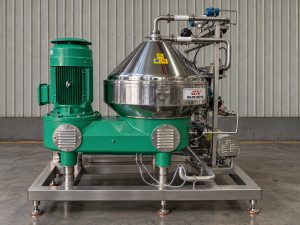
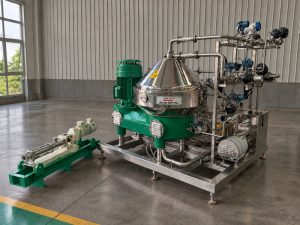
For these applications, GN Separation provides centrifugal separation technologies, including the GN 2-Phase Disc Separator, which can be used as a continuous solution for removing fine solid particles from a liquid phase.
Understanding Seaweed Slurry
After harvesting and preliminary processing, seaweed is commonly washed and mechanically reduced in size. Depending on the final product, the material may be mixed with water to create a pumpable slurry.
This slurry can contain:
Fine seaweed particles
Fibrous material
Sand and other mineral impurities
Suspended organic solids
Process water
Dissolved organic compounds
Traditional screening or sedimentation methods can become less effective when the solid particles are very small. Gravity separation is particularly limited when the density difference between the suspended particles and the liquid is relatively small.
This is where centrifugal separation can provide an advantage.
How a 2-Phase Disc Separator Works
A disc separator uses centrifugal force to accelerate the separation of suspended solids from liquid. Inside the rotating bowl, the feed is introduced into the separation chamber and distributed through a stack of conical discs.
The high rotational speed generates a centrifugal field significantly greater than gravity. As a result, suspended particles migrate toward the outer part of the bowl, while the clarified liquid moves toward the center.
The separated solids accumulate in the solids-holding space and can be discharged depending on the separator configuration.
The term “2-phase” refers to the separation of a solid phase from a liquid phase. For seaweed slurry processing, this configuration can therefore be considered when the objective is primarily to clarify the liquid and remove suspended fine solids.
Why Centrifugal Separation Can Be Useful for Seaweed Processing
One of the main benefits of centrifugal separation is its ability to handle relatively fine suspended particles that may pass through conventional screens.
The disc stack provides a large effective clarification area within a compact machine. This allows the separator to achieve efficient separation without requiring a large settling tank.
A continuous centrifugal process can also help reduce manual handling and provide a more consistent separation process. Depending on the process objective, the clarified liquid may subsequently be sent to filtration, extraction, evaporation, fermentation, or other downstream operations.
Factors Affecting Separation Performance
The performance of a disc separator depends on several process parameters. These include slurry concentration, particle size distribution, particle density, liquid viscosity, temperature, feed flow rate, and the characteristics of the seaweed itself.
For this reason, separator selection should be based on actual process data rather than simply the nominal capacity of the equipment.
The upstream preparation of the seaweed is also important. Excessively large fibers or pieces of seaweed may require grinding, maceration, or screening before entering the centrifugal separator.
Integration into a Seaweed Processing Line
A typical process may include harvesting, washing, size reduction, slurry preparation, centrifugal separation, and subsequent treatment of the liquid and solid streams.
The GN 2-Phase Disc Separator can be positioned after the slurry preparation stage to remove fine suspended solids. The resulting liquid stream can then be directed to the next processing stage, while the concentrated solids can be collected for further treatment or disposal.
The exact process configuration depends on the desired final product. In some applications, the objective may be maximum liquid clarification; in others, the focus may be on recovering valuable organic solids.
Seaweed slurry separation presents specific challenges because of its variable composition, fibrous structure, and potentially high concentration of fine organic particles. Centrifugal separation provides a continuous method for separating fine suspended solids from liquid and can complement other technologies used in seaweed processing.
The GN 2-Phase Disc Separator is designed around high-speed centrifugal separation and can be considered for applications where efficient solid-liquid separation is required.
Before selecting the equipment, laboratory testing or pilot-scale evaluation is recommended to determine the appropriate capacity, configuration, and operating parameters for the specific seaweed slurry. Factors such as solids concentration, particle size, viscosity, temperature, and desired separation efficiency should all be considered during the process design.