As urbanization and infrastructure development continue to accelerate across the Middle East, tunnel construction projects have become increasingly important for transportation, utilities, water management, and underground infrastructure. Many of these projects rely on slurry shield Tunnel Borinblogg Machines (TBMs), which require a stable and efficient slurry circulation system to maintain excavation pressure, transport excavated material, and ensure continuous tunneling operations.
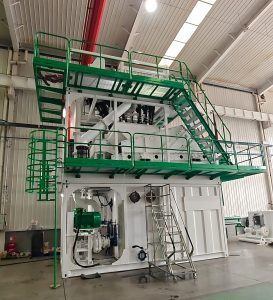
To support these demanding requirements, GN Separation recently supplied the GNTBM-500B Slurry Separation Plant for a major TBM project in the Middle East. Designed specifically for slurry balance tunneling operations, the system provides reliable solids control and slurry recycling capabilities while reducing operating costs and minimizing environmental impact.
The GNTBM-500B is engineered with a processing capacity of 500 cubic meters per hour, making it suitable for medium and large tunnel excavation projects. This processing capacity allows contractors to maintain stable slurry properties while handling the large volumes of excavated material generated during TBM operations. Maintaining consistent slurry quality is critical because slurry density, viscosity, and particle content directly influence face pressure stability and tunneling performance.
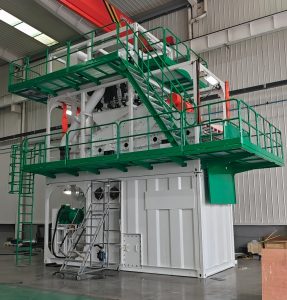
One of the major advantages of the GNTBM-500B system is its multi-stage separation process. Excavated slurry first enters the primary screening stage, where large rocks and coarse particles are removed using high-performance vibrating screens. Removing these larger solids at the initial stage protects downstream equipment and improves the efficiency of subsequent separation processes.
After primary screening, the slurry is transferred to the desander section, where hydrocyclones remove medium-sized particles. The slurry then enters the desilter stage for the removal of finer solids. This staged treatment process allows the system to efficiently separate solids across a wide particle size range, ensuring that the recycled slurry maintains the required characteristics for continuous TBM operation.
For projects requiring even finer solids removal, the system can be integrated with decanter centrifuges and chemical dosing units. Decanter centrifuges are capable of removing particles down to several microns, while polymer-assisted treatment can further improve clarification performance and water recovery. This additional treatment stage is particularly valuable in projects involving clay-rich formations or strict environmental discharge requirements.
The Middle East presents unique challenges for slurry treatment systems. High ambient temperatures, abrasive formations, and remote project locations demand equipment that is robust, reliable, and easy to maintain. The modular design of the GNTBM-500B addresses these requirements by allowing rapid transportation, installation, and commissioning while minimizing the construction footprint on site.
The compact modular arrangement also simplifies relocation between tunnel sections or future projects. Components can be transported individually and assembled quickly, reducing project downtime and improving equipment utilization rates. This flexibility has become increasingly important as contractors seek to optimize equipment investments across multiple projects.
Another important consideration in modern tunneling projects is sustainability. Disposal of untreated slurry can generate significant environmental and logistical challenges, particularly in densely populated urban environments. By recovering reusable slurry and reducing waste volumes, the GNTBM-500B contributes to lower water consumption, reduced disposal costs, and improved environmental compliance.
In addition to operational benefits, slurry recycling also helps reduce wear on pumps, pipelines, and TBM components. Cleaner slurry results in lower abrasive loading throughout the circulation system, extending equipment life and reducing maintenance requirements.
The GNTBM-500B belongs to a complete family of TBM slurry separation systems ranging from 120 m³/h to 3,000 m³/h, allowing customized solutions based on tunnel diameter, geological conditions, and project production targets. Systems can be configured individually or combined to support larger excavation programs and higher slurry flow rates.
As underground infrastructure projects continue to expand throughout the Middle East, efficient slurry treatment technology will remain an essential component of successful TBM operations. The deployment of the GNTBM-500B demonstrates the growing demand for high-capacity, reliable, and environmentally responsible slurry management solutions capable of supporting the next generation of tunneling projects.