In modern solids control and wastewater treatment applications, efficient dewatering and precise chemical conditioning play a critical role in achieving optimal separation performance. Recently, a batch consisting of a screw press system and a chemical dosing unit was prepared for an overseas customer, highlighting the increasing global demand for integrated dewatering solutions.
The screw press is widely recognized for its continuous dewatering capability, low energy consumption, and simple operation. It is commonly used in municipal sludge treatment, industrial wastewater, and oilfield drilling waste management. Its working principle relies on gradually increasing pressure through a rotating screw shaft inside a cylindrical screen. As the material moves forward, free water is separated and discharged, while solids are compacted and discharged at the end of the chamber.
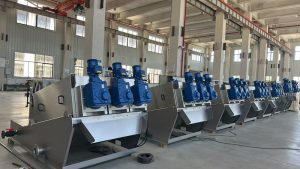
One of the key advantages of the screw press is its ability to operate with minimal supervision. Unlike high-speed centrifuges, it runs at low speed, reducing wear and maintenance requirements. This makes it especially suitable for remote locations or continuous 24/7 operations.
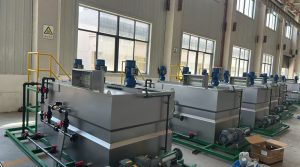
In this project, the screw press was paired with a chemical dosing unit, designed to improve flocculation efficiency. The dosing system ensures that the correct amount of polymer or chemical agent is injected into the slurry before entering the dewatering stage. Proper chemical conditioning significantly enhances solid-liquid separation, improving cake dryness and reducing operating costs.
The chemical dosing unit typically includes solution tanks, agitators, dosing pumps, and a control system. Its accuracy is essential because overdosing increases operational costs, while underdosing reduces dewatering efficiency. The integration of this system with the screw press allows for better process stability and consistent output quality.
For overseas customers, modular design and easy installation are key requirements. Equipment is often shipped in containerized form, allowing quick assembly on site. In addition, remote technical support and clear installation manuals are provided to ensure smooth commissioning.
This type of combined system is increasingly used in food processing waste, paper mill sludge, and others. The trend clearly shows a shift toward compact, energy-efficient, and automated treatment solutions.
As environmental regulations become stricter worldwide, technologies like screw presses combined with chemical dosing systems will continue to play an important role in sustainable waste management strategies.