Solids Separation and Drilling Fluid Recovery Solutions for HDD and Pipe Jacking Applications
Trenchless technology has become an increasingly important construction method for installing underground pipelines, utility networks, water distribution systems, and other infrastructure. Unlike conventional open-cut construction, trenchless methods allow contractors to complete underground installations while reducing surface excavation, minimizing disruption to existing infrastructure, and limiting interference with surrounding activities.
Two widely used technologies in this sector are Horizontal Directional Drilling (HDD) and Pipe Jacking. Although both methods involve underground construction, they have different operating principles and fluid management requirements.
In many of these projects, drilling fluids or slurry systems play an essential role in transporting excavated material, supporting ground stability, reducing friction, and maintaining efficient excavation operations.
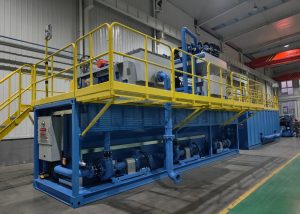
As drilling progresses, the circulating fluid accumulates sand, clay, silt, and other solid particles. These contaminants must be removed to maintain suitable fluid properties and allow the recovered fluid to be reused in the operation.
To support these applications, GN Solids Control has sold two mud treatment systems to a trenchless construction company: one GNMS-1000 system for HDD operations and one GNTBM-360 system for slurry separation in Pipe Jacking projects.
Although both systems are designed for solids separation and fluid recovery, each one addresses different operational requirements.
1. GNMS-1000: Mud Treatment System for Horizontal Directional Drilling (HDD)
Horizontal Directional Drilling (HDD) is a trenchless installation technique commonly used for pipelines, water lines, gas distribution networks, electrical conduits, and other underground utilities.
The process involves drilling along a predetermined underground path, followed by the installation of the required pipeline or conduit. Drilling fluid is continuously circulated through the drill string and returned to the surface, carrying excavated solids from the borehole.
The drilling fluid, commonly prepared using water and bentonite, performs several important functions:
Transports drilled cuttings from the borehole to the surface.
Helps maintain borehole stability.
Reduces friction during drilling operations.
Supports the drilling process by maintaining appropriate fluid properties.
Facilitates the transportation of excavated material.
As the fluid returns to the surface, it contains different concentrations and sizes of solid particles. Without proper treatment, these particles can accumulate in the circulating system, affecting fluid performance and increasing the consumption of water, bentonite, and other additives.
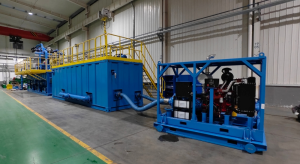
For this application, GN Solids Control supplied a GNMS-1000 HDD mud treatment system, equipped with three main components:
Shale Shaker
The shale shaker is the primary solids separation equipment. It uses vibrating screens to remove larger particles from the returning drilling fluid.
The selection of the appropriate screen mesh is important because it determines the particle size that can pass through the screening surface. Proper screening helps reduce the solids loading entering downstream equipment.
Mud Cleaner
The mud cleaner combines hydrocyclone separation technology with an underflow shale shaker.
The hydrocyclones separate particles according to their physical characteristics and operating conditions. The separated solids are discharged onto the lower shaker, where additional liquid can be recovered before the solids are removed from the system.
This combination provides an additional treatment stage for removing finer solids from the drilling fluid.
Diesel-Driven Mud Mixing Pump
The system also includes a diesel-driven mud mixing pump, which supports the preparation and mixing of drilling fluids.
Proper fluid preparation is essential in HDD operations because bentonite concentration, viscosity, and other fluid properties must be adjusted according to the geological conditions and drilling requirements.
The combination of these components provides an integrated approach to drilling fluid treatment and preparation.
By removing accumulated solids and recovering usable drilling fluid, the system helps contractors manage fluid consumption, reduce waste generation, and maintain more consistent operating conditions.
Learn more about GN’s HDD Mud Recycling Systems.
2. GNTBM-360: Slurry Separation System for Pipe Jacking Projects
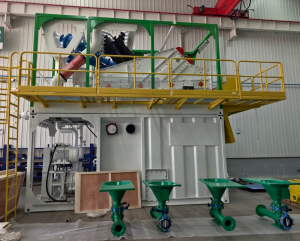
The second system supplied is the GNTBM-360 Slurry Separation Plant, designed for slurry treatment applications associated with Tunnel Boring Machines (TBM) and Pipe Jacking projects.
Pipe Jacking is a trenchless construction technique in which prefabricated pipes are progressively pushed through the ground using hydraulic jacking equipment installed in a launching shaft.
Depending on the excavation method and ground conditions, slurry-based systems may be used to transport excavated material from the cutting face to the surface.
During operation, the returning slurry contains water, bentonite, and excavated solids. This mixture must be processed to separate the solid particles and recover the liquid phase for recirculation.
The GNTBM-360 belongs to GN Solids Control’s TBM slurry separation equipment range. The model is associated with a nominal processing capacity of up to 360 m³/h, depending on the operating conditions and system configuration.
Its treatment process can incorporate several separation stages.
Primary Separation – Shale Shaker
The first stage uses a shale shaker to remove larger excavated particles from the incoming slurry.
This initial separation reduces the solids loading entering the downstream equipment and helps protect subsequent separation stages.
Secondary Separation – Mud Cleaner
After primary screening, the slurry can be processed through a mud cleaner equipped with a lower screening deck and hydrocyclones.
The hydrocyclones separate smaller solid particles from the liquid phase, while the underflow shaker helps recover additional fluid from the discharged solids.
Additional Separation – Desander and Desilter
The desander and desilter hydrocyclones provide additional separation stages for removing finer particles.
Desanders are generally used to remove sand-sized particles, while desilters target smaller solid fractions.
The actual separation performance depends on particle size distribution, slurry density, viscosity, feed pressure, and operating conditions.
Once the slurry has passed through the separation process, the recovered fluid can be returned to the circulation system, while the separated solids are collected for further handling and disposal.
This approach helps maintain slurry circulation and reduces the amount of fluid that must be replaced during excavation.
Discover more about GN’s TBM and Pipe Jacking Slurry Separation Plants.
3. Understanding the Differences Between HDD and Pipe Jacking Mud Systems
Although HDD and Pipe Jacking both rely on fluid management and solids separation, their operating requirements are not identical.
The GNMS-1000 and GNTBM-360 represent two different approaches to treating drilling fluids and excavation slurry.
| Feature | GNMS-1000 | GNTBM-360 |
| Main application | Horizontal Directional Drilling | Pipe Jacking and TBM projects |
| Main purpose | Drilling fluid cleaning and recovery | Excavation slurry separation and recovery |
| Main equipment | Shale shaker, mud cleaner, diesel-driven mixing pump | Shale shaker, mud cleaner and hydrocyclones |
| Treatment objective | Maintain suitable drilling fluid properties | Recover circulating slurry and remove excavated solids |
| Nominal model capacity | Model designation | Up to 360 m³/h |
The selection of a mud treatment system should always consider the specific requirements of the project.
Important factors include drilling diameter, geological conditions, excavation rate, slurry flow rate, solids concentration, particle size distribution, and the required fluid properties.
A system designed for HDD operations may not necessarily be suitable for a Pipe Jacking application without modifications to its configuration and processing capacity.
For this reason, proper equipment selection and system integration are essential for achieving satisfactory treatment performance.
4. Why Slurry Recycling Matters in Trenchless Construction
Slurry recycling is an important part of modern underground construction because it can improve fluid management and reduce operational waste.
One of its main advantages is the ability to recover and reuse a portion of the circulating fluid rather than continuously preparing new drilling mud or slurry.
This can provide several operational benefits:
Reduced water consumption: Recovering the liquid phase helps reduce the need for fresh water, depending on the recycling efficiency and project conditions.
Lower fluid preparation costs: Reusing treated fluid can reduce the consumption of bentonite and other additives.
Improved solids management: Removing accumulated solids helps maintain more consistent fluid properties and reduces the solids loading within the circulation system.
Reduced waste volume: Separating excavated solids from the liquid phase can decrease the volume of material requiring transportation and disposal.
More controlled operations: Multiple separation stages allow contractors to manage different particle sizes and adapt the treatment process to changing ground conditions.
However, effective slurry recycling requires more than simply installing separation equipment. Operators must also monitor fluid density, viscosity, solids concentration, hydrocyclone operating pressure, screen condition, and system flow rates.
The performance of the complete system depends on the interaction between these variables.
5. Integrated Solids Separation Solutions for Underground Construction
The sale of the GNMS-1000 and GNTBM-360 highlights two important applications within the trenchless construction industry.
The GNMS-1000 provides a mud treatment solution for Horizontal Directional Drilling operations, combining shale shaker screening, mud cleaning, and diesel-driven fluid mixing.
The GNTBM-360 addresses the different requirements of slurry separation in Pipe Jacking and TBM applications, where the treatment process focuses on separating excavated solids and recovering the circulating fluid.
Both systems demonstrate the importance of selecting appropriate solids separation equipment according to the excavation method and project requirements.
GN Solids Control develops solids and liquid separation solutions for different industries, including HDD, tunnel construction, mining, oil and gas drilling, and wastewater treatment.
As underground infrastructure projects continue to expand, efficient fluid management and solids separation will remain important factors in improving construction operations and reducing waste.
Explore more GN Solids Control solutions:
GN Solids Control – Solids and Liquid Separation Equipment
#GNSolidsControl #HDD #PipeJacking #TrenchlessTechnology #MudRecycling #TBM #SlurrySeparation #SolidsControl